Who's Behind Lights On Falcon
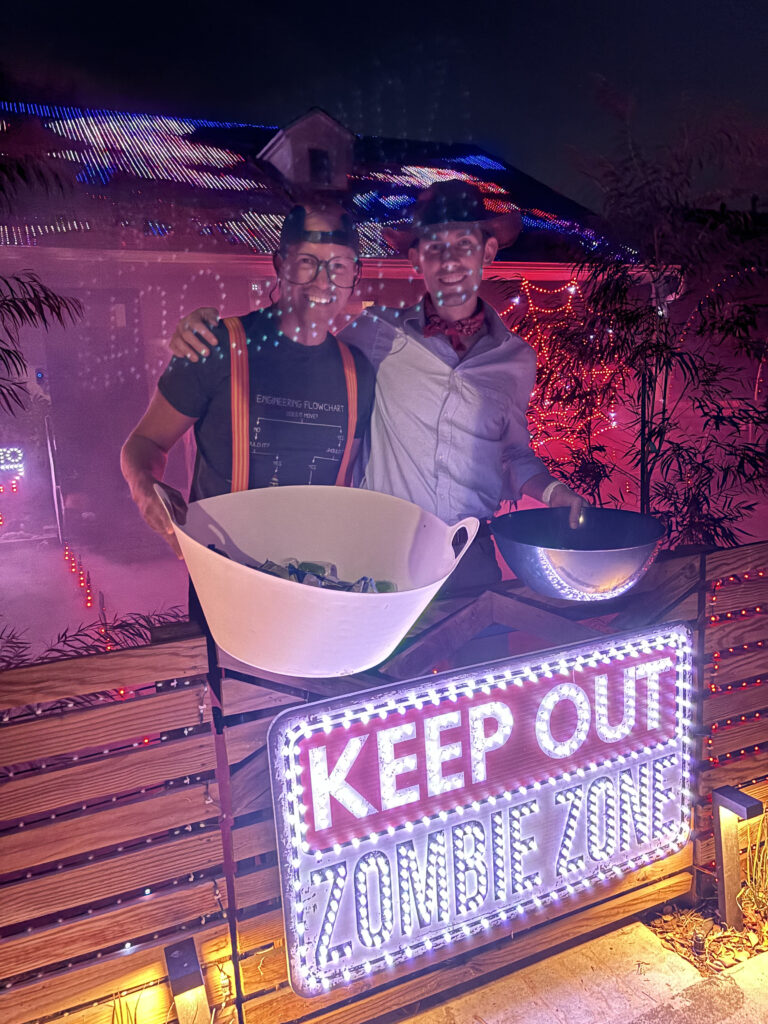
We’re Joe and Chris — the duo behind Lights on Falcon and the two people most likely to be found outside with a headlamp, a zip tie, and a very questionable plan.
Joe’s the one who has always been fascinated by lights, wiring, engineering, and “just one more controller.” Chris is the one who says things like, “Maybe let’s measure it first?” and “Do we really need a fourth Raspberry Pi?” Spoiler alert: Joe’s answer is alwasy a resounding YES, we really do.
Lights on Falcon started as a simple idea — bring a little joy to the block, make the season brighter, and help neighbors feel more connected. Then it snowballed into something bigger: arches built by neighbors, families gathering in the street, kids dancing, and a shared sense of “wow… this is our community.”
Every prop, every cable, every custom mount is built by hand. Nothing is off-the-shelf — not because we’re purists, but because Joe can’t find a retail product he doesn’t want to modify. The show grows each year, evolves each season, and occasionally tests the limits of what Chris is willing to tolerate. But somehow, it always turns out magical.
And there’s more ahead.
Lights on Falcon sparked something bigger — a vision for using creativity, tech, and community to bring people together. That’s why we’re launching LightLab Community Arts Foundation in the new year. It’s still early, but we’re excited to expand this little spark into something that can uplift people year-round.
Thanks for being part of it. Truly.
⚡️What powers our show?⚡️
You asked for the technical details.
We love your curiosity — here’s everything glowing, humming, spinning, calculating, and occasionally arguing with us behind the scenes.
💡100,000+ Individually Addressable LEDs (WS2811)
Each pixel is its own tiny lightbulb with its own tiny opinions.
Spaced 2–4 inches apart, that’s roughly a mile of lights woven across arches, roofs, fences, windows, and whatever else would politely hold still.
At 40+ frames per second, the system pushes out millions of pixel commands every second.
Your retinas never stood a chance.
🔌 30 Meanwell 12V / 600W Power Supplies
Total available output: 18,000 watts of festive electricity.
Or, as Chris calls it: “Joe’s emotional support voltage.”
They’re monitored, balanced, cooled, and surprisingly well-behaved — for now.
🖥️ 11 Gigabit Light Controllers
Each controller handles tens of thousands of pixels like an over-caffeinated conductor leading a sparkly orchestra.
Now running DDP instead of E1.31
→ dramatically reduced network traffic
→ smoother playback
→ Joe sleeps 1% better
(Chris reports no change.)
Total channels: ~249,996 across 60+ universes of mapped data.
Yes, that is as absurd as it sounds.
🧠 Proxmox Cluster Running Multiple Virtual Machines
Dedicated instances power:
• Show routing
• API and REST endpoints
• The website
• Viewer interactions
• Automation scheduling
• CrowdCounter
• Debug dashboards
• And Joe’s late-night experiment projects that Chris learns about after they break something
On busy nights, the cluster handles thousands of requests without sweating.
(We sweat. The cluster doesn’t.)
🍓 Two Raspberry Pi 5s + One Pi 4 + One Pi 3 — All Powered by PoE
The Pi 5s run NVMe disks because SD cards simply couldn’t keep up with Joe’s ambition.
These Pis manage:
• Live show playback
• Network services
• Audio routing
• Custom triggers
• Show state
• Redundancy failovers
• All the things no one sees but everyone benefits from
Pi 3? Still here. Still trying. We love an underdog.
📡 FM Transmitter with Live I²C Telemetry
Yes, you can listen from your car.
Yes, it’s tightly synced.
No, we will not explain how many hours went into that sync.
(We lost count. And sleep.)
🔈 Automatic Speaker Synchronization Beta (New This Year!)
We’ve all been there — your song ends, the speaker cuts off, and someone sprints toward the button like it’s the Olympics.
Not anymore.
Now the system detects whether a requested song is still playing and extends speaker time automatically, so you can enjoy the whole track without running toward anything.
The speaker is finally… civilized.
📱 Live Streaming With Latency-Adaptive Sync Beta (New This Year!)
Joe hand-coded a streaming engine that adjusts audio timing on your phone to account for:
• network latency
• cell carrier delays
• internet jitter
• time dilation (probably)
So your phone audio matches the real-world show as closely as physics will allow.
If it drifts? Joe notices. Joe fixes. Joe does not rest.
🧵 1,000+ Feet of Power Cabling + 1,000+ Feet of Data Lines
If stretched end-to-end, it would run for several miles — creating the world’s least practical but most festive highway.
Each cable was hand-run, tested, retested, zip-tied, labeled, renamed, and occasionally sworn at.
🌐 Industrial Fiber-Backed Network Backbone
Most homes have Wi-Fi.
We have:
• fiber uplinks
• managed switches
• VLANs
• dedicated show networks
• broadcast domains
• and diagrams that scare visitors
• (and sometimes Chris)
🧮 CrowdCounter Technology
Anonymous, privacy-respecting estimation of how many people are nearby using purely RF signals.
On peak nights, hundreds of devices move through the detection zone.
It helps us understand visitor flow and keeps the neighborhood comfortable.
Also Joe really likes charts.
🔧 100% Hand-Built Everything
No kits.
No prefab props.
No plug-and-play anything.
It’s all:
• measured
• cut
• coded
• soldered
• welded
• wired
• configured
• zip-tied
• tested
• improved
• rebuilt
• and loved
by hand.
🕒 Uptime Metrics? Funny You Should Ask.
There is no “uptime.”
There is only Joe building, tweaking, testing, improving, optimizing, refactoring, rebuilding, tuning, and occasionally breaking things at 2AM.
If the show is running, it’s because he finally stepped away from the keyboard.
Chris would like the record to show he tries.